Chak Phupha
Su Maha Nathee Park
Bangkok, Thailand
Rewild your play and reconnect amid the urban forest and the rhythm of flow.
Chak Phupha Su Maha Nathee Park transforms a former hardscape parking lot into a living forest and water landscape shaped by memory, ecology, and play. Rooted in the planting legacy of HM Queen Sirikit, the Queen Mother, the project restores ecological processes through wetland systems, layered planting, and immersive topography while expanding Bangkok’s northern green network. More than a commemorative park, it frames nature not as scenery, but as an active and accessible part of everyday urban life.
Project Information ↘︎
Client & Developer
Bangkok Metropolitan Administration (BMA)
Architect
Creative Crews
Status
Completed
Landscape Area
41,600 sq.m.
Year
2024
Award
TALA Awards 2021
Design Director
Namchai Saensupha
Landscape Architect
Kwanchanok Kongchoksamai
Premhathai Charoenweerakul
Raviporn Boonyasai
Panisara Kitisuthatham
Horticulturist
Phanicha Woracharnrat
Collaborator
Forestry Expert: Nopporn Nontapa
Bird Conservation Society of Thailand (BCST):
Dr. Boripat Siriaroonrat
Urban Planning Expert:
Assoc. Prof. Dr. Panit Pujinda
Brownfield Specialist:
Asst. Prof. Dr. Angsana Boonyobhas
Main Contractor: Trio Bright Co., Ltd.
Lighting Designer: BE LIT
M&E: INFRA GROUP
C&S: INFRA GROUP
Photographer: Nawin Deangnul
Graphic Designer: Patcharamai suwannachot
Chak Phupha Su Maha Nathee Park is a 41,600 sqm public botanical park that commemorates the 90th Birthday Anniversary of Her Majesty Queen Sirikit, The Queen Mother. The project collects plant species that Her Majesty personally planted during her royal duties across Thailand. The design intention is to create a landscape where people learn to live in harmony with forest ecosystems.
The site is located between Queen Sirikit Park, Wachirabenchathat Park, and Chatuchak Park, one of Bangkok’s most significant clusters of green spaces. This position gives the site inherent potential to function as a connector within the city’s northern green network. The landscape design responds by organizing entrances and circulation routes that extend existing park systems. The main entrance along Kamphaeng Phet 3 Road strengthens access, allowing users to experience multiple parks as a connected urban landscape.
The site was previously an impervious paved area used as a parking lot for the JJ Green Market. The design transforms this condition through integrated landscape strategies that restore ecological function while supporting public use. Concrete fragments from the original pavement were reused on site to construct landforms ranging from 1.00 to 3.50 meters in height. These hills, slopes, terraces, and low basins create spatial diversity while retaining and infiltrating stormwater before it enters the subsurface drainage system, supporting urban flood mitigation.
A forest-based botanical strategy structures planting throughout the park. More than 2,400 trees representing over 100 species are planted across upper canopy, mid-canopy, and understory tree layers, excluding shrubs and groundcover species. The planting combines 913 large transplanted trees, 955 medium-sized trees, and 561 young seedlings.
This layered and multi-aged approach establishes immediate spatial structure while allowing canopy cover, habitat complexity, and ecological processes to develop progressively over time. Planting is conceived as a long-term climate strategy, supporting urban heat mitigation, carbon storage, and ecological resilience as the landscape matures.
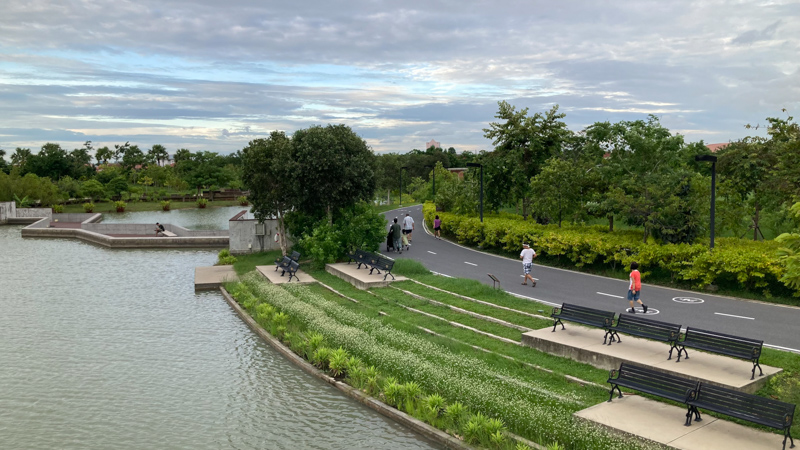
Water acts as a primary organizing element of the park. A constructed wetland filters and improves water quality before feeding a linear stream running through the site. Treated through the wetland system, shallow stream zones, and designated water-play areas, the water allows people of all ages to safely engage with it, fostering everyday contact with natural processes. Universal accessibility is integrated throughout.
Chak Phupha Su Maha Nathee Park reclaims a former hardscape parking lot as a performative green public landscape, where ecological processes and human activities are tightly interwoven. It supports play, learning, and environmental awareness while operating as a living system that evolves and adapts over time.
At the urban scale, the park acts as connective green infrastructure within Bangkok’s northern park system. By stitching together adjacent open spaces through continuous circulation, it consolidates fragmented landscapes into a coherent network and expands the reach of everyday public life.